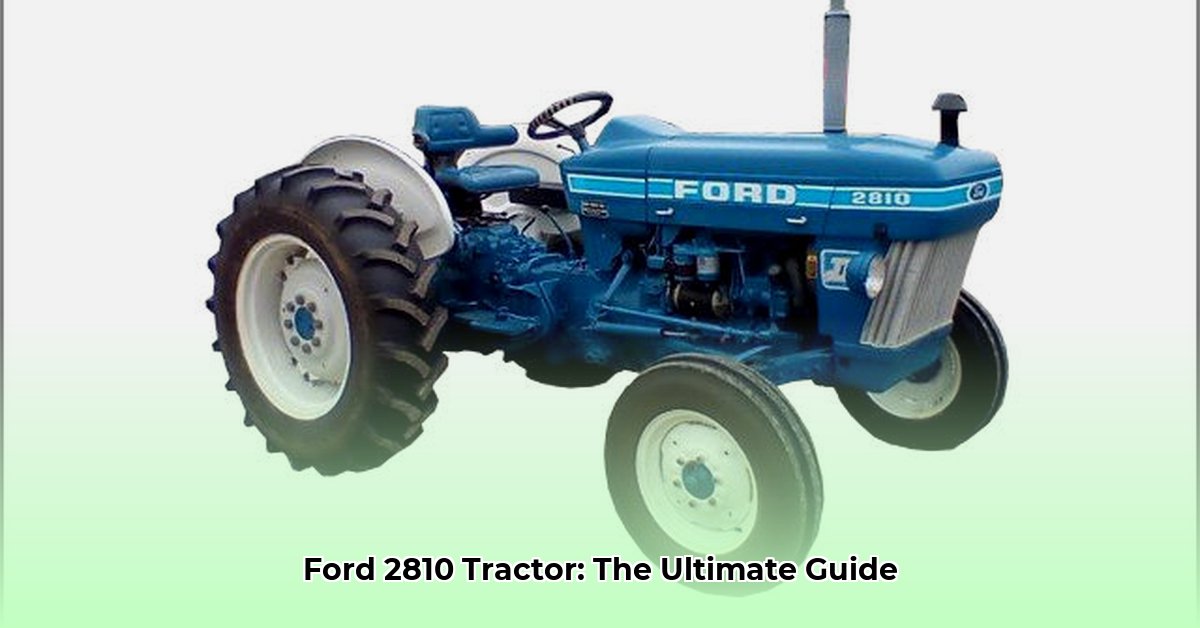
The Ford 2810, a stalwart of the 1980s agricultural landscape, remains a popular choice among collectors and farmers alike. This comprehensive guide delves into the detailed specifications of this classic tractor, exploring its engine, transmission, hydraulics, and historical context. We'll also discuss its current market value and the challenges of restoration. For more information on similar models, check out this helpful resource on the Ford 2910.
Engine Specifications: Powering the Ford 2810
The Ford 2810's heart is a robust 2.6-liter, three-cylinder diesel engine. While sources vary slightly on the exact horsepower (some cite 34 hp, others 36 hp), its performance was consistently described as reliable and suitable for a range of farm tasks. Wasn't it surprisingly powerful for its size? This consistent performance contributed to the tractor's enduring popularity amongst farmers. The engine's dependability made it a favorite amongst those needing a hardworking, yet manageable machine for everyday farm chores.
Transmission and Drivetrain: Smooth Operation and Versatility
The Ford 2810 offered different transmission options, tailoring the tractor to individual farming requirements. The most common setup featured an 8-forward, 2-reverse gearbox, a dual range configuration delivering flexibility for various speeds. Some models also included a 6-forward, 4-reverse mechanical shuttle transmission. This transmission choice was a significant factor in the tractor's broad appeal, ensuring a suitable fit for various farmers' unique demands. The availability of multiple shift patterns ensured a comfortable operating experience.
Hydraulic System: Lifting and Powering Implements
The hydraulic system of the Ford 2810 is designed to handle a diverse array of implements, providing essential power for loaders and other attachments. Determining the precise lift capacity is challenging due to data inconsistencies across various sources. Therefore, it's essential to consult your specific tractor's manual to obtain this vital information. The hydraulics were, however, generally noted as being more than sufficient for typical tasks, bolstering the tractor's overall capabilities.
Dimensions, Weight, and Other Key Specifications: A Detailed Overview
The Ford 2810's physical dimensions varied subtly between two-wheel-drive (2WD) and four-wheel-drive (4WD) variations, with the 4WD model understandably heavier. Consistent data on length, width, height, and weight is scarce due to inconsistent record-keeping. Fuel tank capacity and PTO (Power Take-Off) speed similarly show variability across sources. Always consult the Ford 2810 owner's manual for the most accurate figures relevant to your specific tractor model. This information is essential for proper maintenance and operation.
Key Specifications at a Glance
The following table summarizes the key specifications, emphasizing the variations encountered:
| Specification | Typical Value (Approximate) | Notes |
|---|---|---|
| Engine Type | 2.6L, 3-cylinder Diesel | Power output may vary slightly depending on the model and year. |
| Horsepower | 34-36 hp | Varies based on measurement method (PTO or rated). |
| Transmission | 8F/2R or 6F/4R | Transmission type varied depending on year and production run. |
| Fuel Tank Capacity | Variable | Varies significantly based on model (2WD/4WD). |
| PTO Speed | Variable | Always consult the owner's manual. |
| Hydraulic Lift Capacity | Variable | Depends on the specific hydraulic setup and attachments. |
Historical Context and Collector's Market: A Look Back
The Ford 2810 held a prominent position in the 1980s farm machinery market, gaining popularity for its balanced power, reliability, and affordability. Today, it enjoys a resurgence, particularly among collectors attracted to its simple yet robust design. The challenge lies in parts availability, but devoted online communities and specialized suppliers facilitate these restoration endeavors. The value of a Ford 2810 is highly dependent on its condition, with well-preserved examples commanding higher prices.
Comparing the Ford 2810 to Modern Tractors: A Generational Leap
Comparing the Ford 2810 to modern tractors highlights significant advancements. Modern equivalents offer superior fuel efficiency, enhanced electronic controls for easier operation, advanced safety features, and substantially more powerful hydraulic systems. However, the Ford 2810’s enduring appeal rests on its straightforward design, robust construction, and nostalgic charm. It represents a testament to the engineering quality of its era.
Conclusion: Legacy of a Workhorse
The Ford 2810 remains a fascinating study in agricultural engineering. This guide aims to provide a comprehensive resource for those seeking to understand the specifications, history, and collectibility of this classic tractor. Remember to always consult your specific tractor's owner's manual for the most accurate and detailed specifications. The variability in data reinforces the importance of consulting original documentation for accurate details.